Trip Planning for Skiers: How to Plan Mountain Missions Like a Pro

Copy and save this to your phone!
Trip planning isn’t a formality. It’s a skill. When you treat it that way, your days get safer, smoother, and more satisfying. Structured planning sets you up for better decisions, efficient travel, and the kind of margin pros rely on.
This guide breaks down mountain trip planning, backcountry route planning, and the essential backcountry ski planning tools you should use before every tour.
1. Start With the Big Picture: Objective, Conditions, and Season
Before you dive into maps, get clear about what kind of day you’re actually building.
Your Objective
Ask yourself: What’s the intent for the day?
Powder lap day
Bigger mission
Long ridge tour
Exploration day
“Let’s see” days (spoiler: these still need a plan)
Conditions
Good mountain trip planning begins with understanding the conditions:
Avalanche forecast and problem types
Weather trends over the last 3–5 days
Snowpack history for the current season
Wind, loading, and temperature swings
Recent observations from the community
This trend-based approach is exactly how pros avoid surprises.
Seasonality
Early season: shallow snowpack, hidden hazards
Midwinter: slab avalanche potential, persistent cold
Spring: timing, freezing levels, solar effect
The same tour skis completely differently in December versus April.
2. Dial In Your Backcountry Route Planning
This is where most recreational skiers shortcut the process. Open your maps — and study them intentionally.
Essential Backcountry Ski Planning Tools
Cal Topo: slope angle shading, aspect, sun exposure — great for desktop planning at home
Avalanche centers: forecast and observations
Time/distance calculators: estimate realistic pacing
Google Earth / historic imagery: identify cliffs, gullies, benches, and terrain transitions
Study Your Route Like a Guide
Break everything into pieces:
Ascent route: efficient and, if possible, not under hazards
Primary descent line
Alternate descents if something doesn’t feel right
Terrain traps and rollovers
Escape options
Ridges you can reach quickly if things deteriorate
Pro tip: Highlight decision points ahead of time and commit to checking in at each one.
3. Navigation and Route Finding: Build a Mental Map
The goal of navigation in ski touring isn’t to “follow the uptrack.” It’s to understand your terrain before you ever step into it.
Build Multiple Layers of Awareness
Map and waypoints
Slope angle and aspect (what’s warming, what’s loading)
Terrain traps and consequential features
Where tree cover thins or disappears
High points, low points, ridgelines, benches
Where you’ll be in time, not just in distance
If you can sketch your line from memory, you’re ready.
4. Build a Real Plan B and Plan C
Most people think they have a backup plan. What they really have is: “Maybe we’ll go somewhere else.”
A real backup plan should:
Have its own ascent route
Have its own timing
Fit the day’s hazard
Live in a different aspect or elevation band
Still feel like a win, not a consolation prize
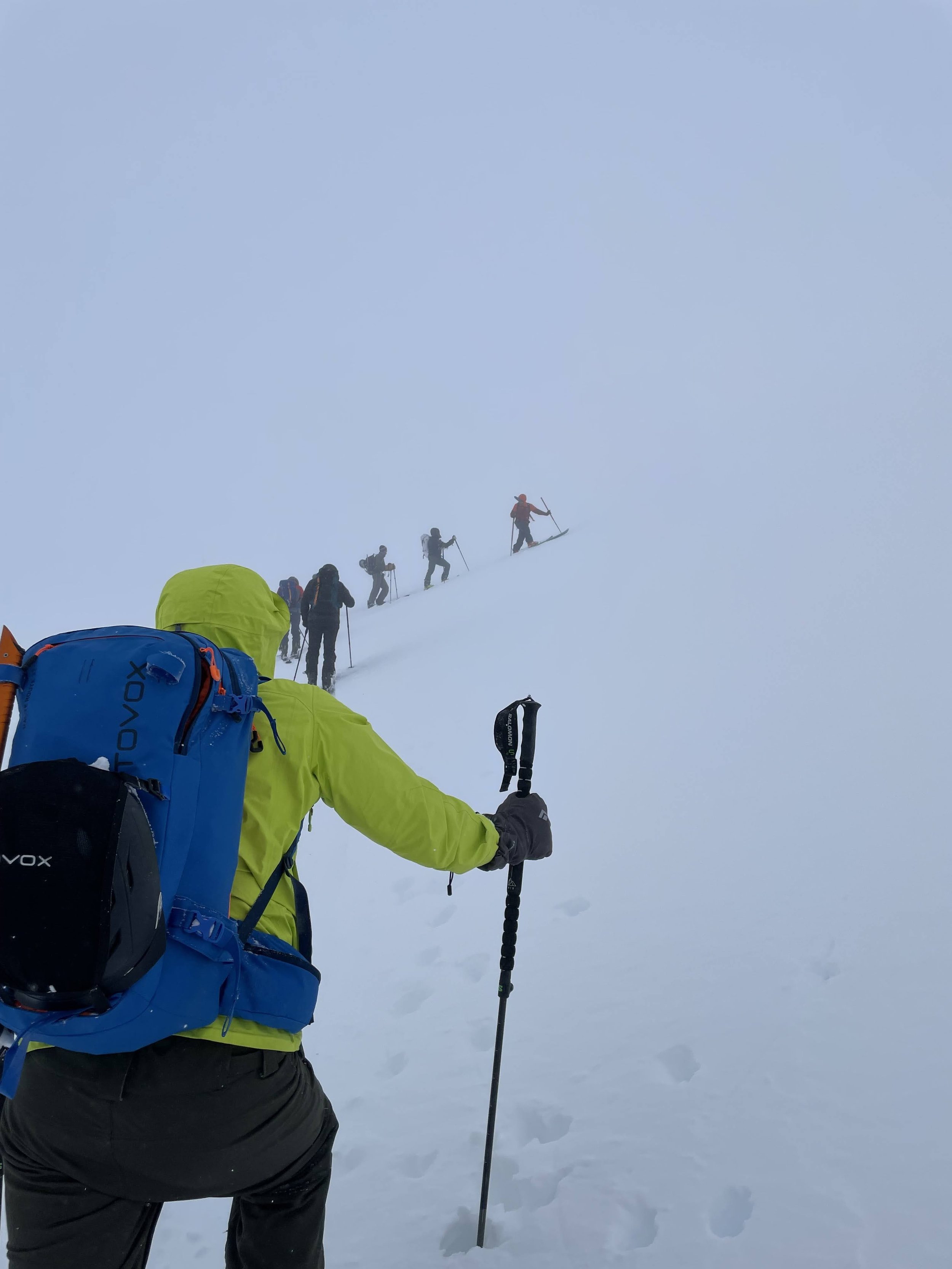
A group of skiers working on “Plan C”
Plan C = guaranteed safe terrain. This keeps you honest when things feel off.
Pro tip: Have an objective trigger for moving from Plan A → B → C (for example, visible wind loading in the start zone).
5. Partner Planning: Your Team Is Part of the System
A great plan fails instantly if your group doesn’t share the same intent.
Before leaving the house:
Agree on the objective and style of the day
Confirm gear basics
Decide roles: pacing, navigation, and timekeeping
Share the plan so everyone knows the decision points
Discuss group gear: first aid, extra layers, repair kit, etc.
If one partner is secretly thinking big line day and another is thinking pow laps, you’re setting yourself up for friction.
6. The Pre-Trip Brief (Your Pro-Level Habit)
The night before or at the trailhead, run a quick walkthrough:
Objective: What are we skiing?
Hazard: What’s the avalanche problem and trend?
Route: Ascent, descent, decision points
Timing: Estimated travel times and turnaround
Backups: Plan B and Plan C
Roles: Who leads what
Red Flags: What shuts the day down early?
It takes two minutes but completely changes the flow of your tour.
7. Execute the Plan — And Adjust Early
Planning gives you clarity. Execution gives you judgment.
Throughout the day:
Check if conditions match the forecast
Adjust pace or timing as needed
Use your decision points — don’t blow past them
Switch to Plan B early if terrain or snowpack feels wrong
Make observations constantly: cracking, wind transport, warming, changing sky
Pros don’t hesitate to switch plans. That’s why they get so many good days.
Final Takeaway: Ski Touring Is More Fun When You Plan Like a Pro
Good trip planning doesn’t take away the adventure — it creates space for it. When you show up with a clear objective, multiple options, and a solid grasp of your terrain, you move confidently, make cleaner decisions, and ultimately ski better snow.
If you want to improve your planning, tighten your decision-making, or get real-time coaching on route finding and terrain management, that’s exactly what we teach. Book a day or join one of our winter skills courses, and let’s level up your skiing this season.