Ice Grades Explained: What WI2 to WI6 Really Mean (and How to Progress)
If you’re getting into ice climbing, you’ve probably heard people toss around terms like “It’s just WI2” or “That pillar is solid WI5.” But what do those numbers actually mean? And how do you know when you’re ready to move from WI2 to WI3… or WI4?
This guide breaks down the WI scale in plain English, using real-world examples and the kind of “feel” descriptions you only get from time on the sharp end. By the end, you’ll understand where you fit on the spectrum—and how to progress safely without getting in over your head.
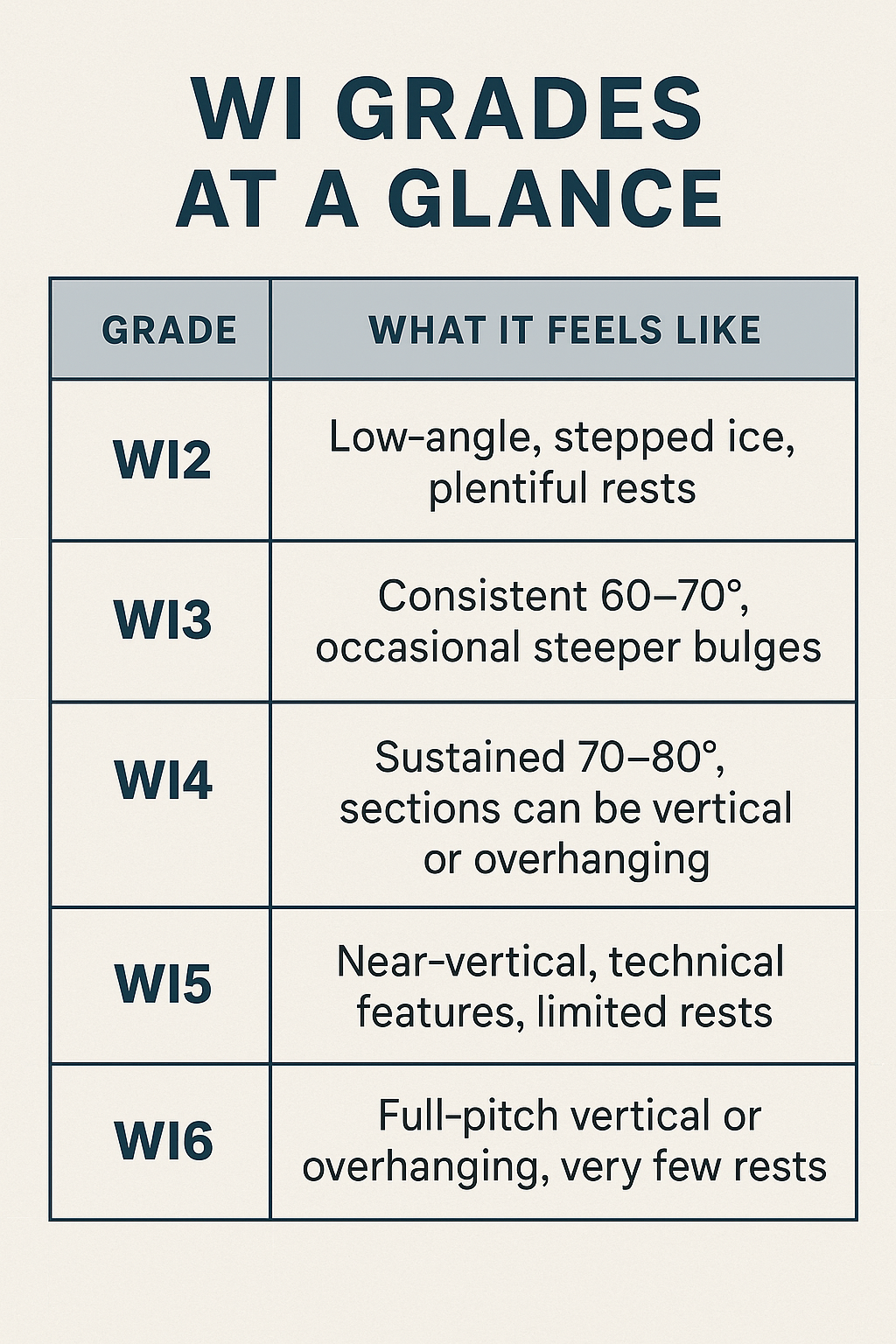
Ice grades at a glance
What Is the WI Scale?
The Water Ice (WI) rating system describes the steepness, continuity, technical difficulty, and protection quality of frozen waterfall routes.
—When climbers talk about ice grades out loud, they don’t usually say “W-I-4.” They just say “Grade 4.”
We write WI4 in text for clarity, but in conversation you’ll hear “Grade 3,” “Grade 4,” etc.
The WI scale isn’t perfect, but it does help you gauge:
how steep the climbing will be
how sustained the pitch is
how pumpy it may feel
how secure or insecure placements are
how difficult protection might be
Think of WI ratings as a spectrum of ice climbing difficulty levels, from mellow steps to sustained vertical climbing.
Ice Grades Aren’t Fixed — Conditions Can Make a Route Way Easier or Way Harder
Unlike rock, ice is alive. It changes every day (and sometimes every hour).
That means the number in a guidebook is a starting point, not a promise.
The same WI grade can feel wildly different depending on:
temperature
moisture content
sun exposure
freeze–thaw cycles
recent traffic
whether it’s hooked-out or untouched
ice type (plastic, brittle, chandeliered, bullet-hard, aerated, “hero ice,” etc.)
A Picked-Out Grade 4 Can Feel Easier Than an Untouched, Brittle Grade 3
If a WI4 has seen a lot of traffic, you might find:
hooked tool placements
kicked-in feet
obvious stances
cleaned-off surfaces
This can make a WI4 feel surprisingly manageable.
But a fresh, untouched WI3 on a cold morning?
That can feel dramatically harder because:
placements dinner-plate
ice is thin or brittle
nothing is hooked
screw placements are finicky or poor
movement requires more precision
pump builds faster due to insecurity
The takeaway:
The WI grade tells you what the climb can be—not exactly what it will be today.
Experienced climbers read conditions just as much as they read the rating.
WI2–WI6 Breakdown: What Each Grade Really Feels Like
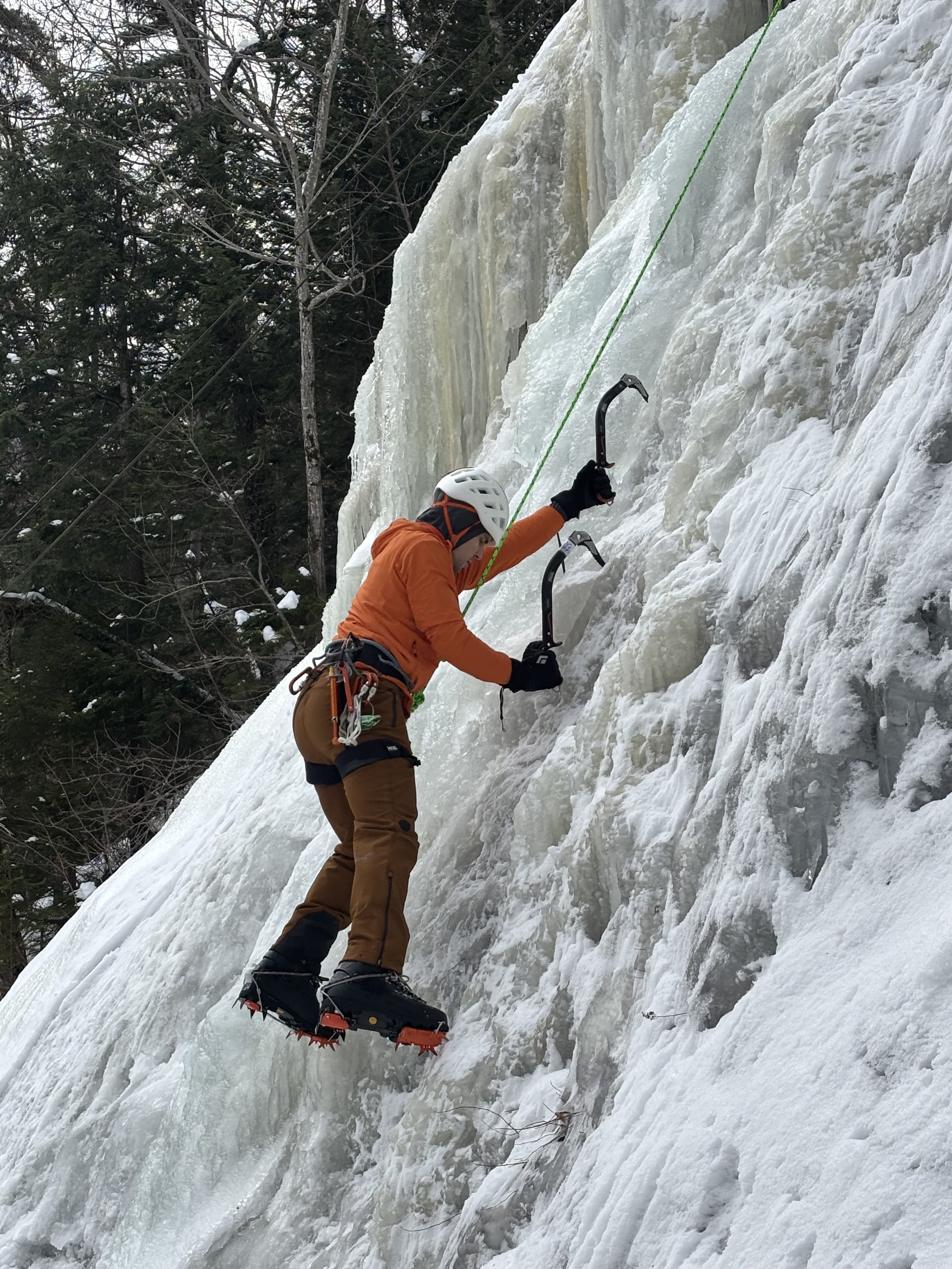
Lower angle- rest wherever- WI2
WI2 — Where we all should start
What WI2 feels like:
Low-angle, stepped ice
Lots of rests- you can basically stop anywhere
Secure placements almost everywhere
Easy screw stances
Perfect terrain for learning swing placement, footwork, and movement basics.
WI3 — This starts to feel “real”
What WI3 feels like:
Consistent 60–70° ice
Some steep bulges
Occasional funky or variable ice
Pump starts to show up if you climb too fast
Screw placement requires more thought
Once WI3 feels controlled, WI4 becomes the next logical step.
WI4 — How Hard Is WI4?
Short answer: harder than people think.
What WI4 feels like:
Sustained 70–80° ice
4-6 body lengths of vertical ice
Fewer obvious rest stances
Pump management becomes essential
Screw placements from less-than-ideal stances
**WI4 is a real jump in physical and mental commitment.
WI5 — Steep, Sustained, and Serious

Steep- Hard- Sustained- WI5
What WI5 feels like:
Near-vertical the whole pitch
Technical features (curtains, pillars, chandeliers)
Precision placements required
Very limited rests
Screw placements can feel pumpy or insecure
This is advanced ice climbing.
WI6 — Elite Terrain
WI6 is not “harder WI5”—it’s a category shift.
What WI6 feels like:
Entire pitch is vertical or even slightly overhanging
Virtually no rests
Delicate or complex features
Requires power, precision, and calm under pump
Very high consequences for poor decisions
WI6 is a long-term goal, not a natural yearly progression.
How to Progress Safely Through the Ice Grades
1. Build Strong Fundamentals on WI2–WI3
You should be able to:
place screws efficiently
swing accurately
kick precise, controlled feet
read ice texture
rest deliberately and often
2. Develop Pump Management Before Steeper Terrain
Practice on WI3:
slow, smooth movement
breathing on every move
resting on stems or high feet
placing screws without panic
3. Step to WI4 Only When You Can:
downclimb calmly
place screws from awkward stances
stay relaxed on steep ice
manage brittle or chandeliered texture
4. Treat WI5–WI6 as Long-Term Projects
These grades demand:
strong aerobic fitness
technical movement
refined ice reading
mental composure
real mileage (years of experience)
Final Thoughts
The WI scale is a useful tool, but it doesn’t tell the whole story. Ice is ever-changing, and a given route can feel easier or harder depending on conditions, traffic, temperature, and real-time texture.
Strong fundamentals and good decision-making matter far more than chasing bigger numbers.
If you want help building those skills—or want a safe, fun day out on ice at any grade—we are always here to guide you.